Welcome to Siva's Blog

~-Scribbles by Sivananda Hanumanthu
My experiences and learnings on Technology, Leadership, Domains, Life and on various topics as a reference!
What you can expect here, it could be something on Java, J2EE, Databases, or altogether on a newer Programming language, Software Engineering Best Practices, Software Architecture, SOA, REST, Web Services, Micro Services, APIs, Technical Architecture, Design, Programming, Cloud, Application Security, Artificial Intelligence, Machine Learning, Big data and Analytics, Integrations, Middleware, Continuous Delivery, DevOps, Cyber Security, Application Security, QA/QE, Automations, Emerging Technologies, B2B, B2C, ERP, SCM, PLM, FinTech, IoT, RegTech or any other domain, Tips & Traps, News, Books, Life experiences, Notes, latest trends and many more...
Showing posts with label API Gateway. Show all posts

Wednesday, September 22, 2021

What Tech Stacks need to be used?

Question: What Tech Stacks need to be used?

Answer: It depends!

Detailed Answer: 

It depends on various aspects of your functional and non-functional requirements. To know more, how this has been solved, then have a look at the following website stackshare to know what tech stacks are better for your specific requirements with a detailed decisions log from more than 1M developers community and with the information of tradeoffs and etc.

https://stackshare.io/feed


Saturday, January 9, 2021

API Gateway vs. Service Mesh

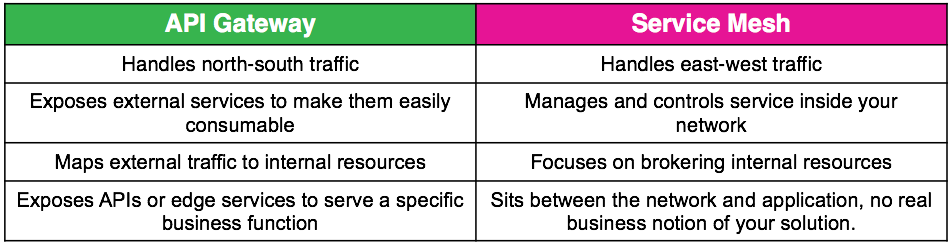
 Service Mesh "How is it different from an API gateway?" It's a good question. The overlap between API gateway and service mesh patterns is significant. They can both handle service discovery, request routing, authentication, rate limiting, and monitoring, but there are differences in architectures and intentions. A service mesh's primary purpose is to manage internal service-to-service communication, while an API Gateway is primarily meant for external client-to-service communication.

Image title

Do You Need Both?

You may be wondering if you need both an API gateway and a service mesh.  Today you probably do, but as service mesh evolves, we believe it will incorporate much of what you get from an API gateway today.

The main purpose of an API gateway is to accept traffic from outside your network and distribute it internally. The main purpose of a service mesh is to route and manage traffic within your network. A service mesh can work with an API gateway to efficiently accept external traffic then effectively route that traffic once it's in your network. The combination of these technologies can be a powerful way to ensure application uptime and resiliency while ensuring your applications are easily consumable.

In a deployment with an API gateway and a service mesh, incoming traffic from outside the cluster would first be routed through the API gateway, then into the mesh. The API gateway could handle authentication, edge routing and other edge functions, while the service mesh provides fine-grained observability of and control of your architecture.

The interesting thing to note is that service mesh technologies are quickly evolving and are starting to take on some of the functions of an API gateway. A great example is the introduction of the Istio v1alpha3 routing API which is available in Aspen Mesh 1.0. Prior to this, Istio had used Kubernetes ingress control which is pretty basic so it made sense to use an API gateway for better functionality. But, the increased functionality introduced by the v1alpha3 API has made it easier to manage large applications and to work with protocols other than HTTP, which was previously something an API gateway was needed to do effectively.

What The Future Holds

The v1alpha3 API provides a good example of how a service mesh is reducing the need for API gateway capabilities. As the cloud-native space evolves and more organizations move to using Docker and Kubernetes to manage their microservice architectures, it seems highly likely that service mesh and API gateway functionality will merge. In the next few years, we believe that standalone API gateways will be used less and less as much of their functionality will be absorbed by service mesh.

References:

https://dzone.com/articles/api-gateway-vs-service-mesh

https://konghq.com/blog/the-difference-between-api-gateways-and-service-mesh/

https://medium.com/microservices-in-practice/service-mesh-vs-api-gateway-a6d814b9bf56

Choosing between the tools is at https://medium.com/@mahesh.mahadevan/my-experiences-with-api-gateways-8a93ad17c4c4

Sunday, May 3, 2020

Kong API Gateway : Best Practices

Let me have some reference notes here in this blog for the best practices that can be followed with respect to the Kong API gateway and their Architecture Patterns.

Background

Kong’s overall infrastructure is composed of three main parts: NGINX provides protocol implementations and worker process management, OpenResty provides Lua integration and hooks into NGINX’s request processing phases, and Kong itself utilizes those hooks to route and transform requests.

Kong Architecture Patterns

  • Simple Kong between client and upstream as 'a proxy'
  • Kong and APIs behind a firewall for more control over the APIs
  • Separate Kong Admin node for better security 
  • Multi-datacenter with Cassandra for high availability to achieve higher throughput

References:

https://docs.konghq.com/enterprise/0.32-x/kong-architecture-patterns/

https://konghq.com/blog/microservices-high-availability/

https://docs.konghq.com/enterprise/0.32-x/kong-architecture-overview/

https://www.codit.eu/blog/kong-the-upcoming-king-of-the-api-jungle/

https://medium.com/swlh/kong-api-gateway-zero-to-production-5b8431495ee


Sunday, March 22, 2020

API Gateway : Architecture Patterns

The simple definition of API Gateway Architecture Pattern is: API gateway Implement a service which is the entry point into the microservices-based application from external API clients. 


As you may know, there are numerous drawbacks with services accessing services directly. It’s often impractical for a client to perform API composition over the Internet. The lack of encapsulation makes it difficult for developers to change service decomposition and APIs. Services sometimes use communication protocols that aren’t suitable outside of the firewall. Consequently, a much better approach is to use what’s known as an API gateway.

An API gateway is a service that is the entry point into the application from the outside world. It’s responsible for request routing, API composition, and other functions, such as authentication. Let’s take a look at the API gateway pattern.

Overview of the API gateway pattern

The drawbacks of clients making multiple requests in order to display information to the user are well known (I describe them in my book!). A much better approach is for a client to make a single request to what’s known as an API gateway. An API gateway is a service that is the single entry-point for API requests into an application from outside the firewall. It’s similar to the Facade pattern from object-oriented design. Like a facade, an API gateway encapsulates the application’s internal architecture and provides an API to its clients. It might also have other responsibilities, such as authentication, monitoring, and rate-limiting. Figure 1 shows the relationship between the clients, the API gateway, and the services.


Figure 1. The API gateway is the single entry-point into the application for API calls from outside the firewall


The API gateway is responsible for request routing, API composition, and protocol translation. All API requests from external clients first go to the API gateway. The API gateway routes some requests to the appropriate service. The gateway handles other requests using the API Composition pattern and invoking multiple services and aggregating the results. It might also translate between client-friendly protocols such as HTTP and WebSockets and client-unfriendly protocols that are used by the services.

Request routing

One of the key functions of an API gateway is request routing. An API gateway implements some API operations by routing requests to the corresponding service. When it receives a request, the API gateway consults a routing map that specifies which service to route the request to. A routing map might, for example, map an HTTP method and path to the HTTP URL of the service. This function is identical to the reverse proxying features provided by web servers such as NGINX.

API Composition

An API gateway typically does more than reverse proxying. It might also implement some API operations using API composition. In my book, I use an example application called FTGO to teach how to move from a monolithic architecture to microservices. The FTGO API gateway, for example, implements the Get Order Details API operation using API composition. As figure 2 shows, the mobile application makes one request to the API gateway, which fetches the order details from multiple services.


Figure 2. An API gateway often does API Composition, which enables a client such as mobile device to efficiently retrieve data using a single API request.


The FTGO API gateway provides a coarse-grained API that enables mobile clients to retrieve the data they need with a single request. For example, the mobile client makes a single getOrderDetails() request to the API gateway.

Protocol translation

An API gateway might also perform protocol translation. The API gateway might provide a RESTful API to external clients even though the application services use a mixture of protocols internally include REST and gRPC. When needed, the implementation of some API operations translate between the RESTful external API and the internal gRPC-based APIs.

The API gateway provides each client with client-specific API

An API gateway could provide a single one-size-fits-all (OSFA) API. The problem with a single API is that different clients often have different requirements. For instance, a third-party application might require the Get Order Details API operation to return the complete Order details, while a mobile client only needs a subset of the data. One way to solve this problem is to give clients the option of specifying in a request which fields and related objects the server should return. This approach is adequate for a public API that must serve a broad range of third-party applications, but it often doesn’t give clients the control they need.

A better approach is for the API gateway to provide each client with its own API. For example, the FTGO API gateway can implement provide the FTGO mobile client with an API that is specifically designed to meet its requirements. It might even have different APIs for the Android and iPhone mobile applications. The API gateway also implements a public API for third-party developers to use.

Implementing edge functions

Although an API gateway’s primary responsibilities are API routing and composition, it may also implement what are known as edge functions. An edge function is, as the name suggests, a request processing function that is implemented at the edge of an application.

Examples of edge functions that an application might implement include:

  • authentication – verifying the identity of the client making the request
  • authorization – verifying that the client is authorized to perform that particular operation
  • rate-limiting – limiting how many requests per second are allowed from either a specific client and/or from all clients
  • caching – cache responses to reduce the number of requests made to the services
  • metrics collection – collect metrics on API usage for billing analytics purposes
  • request logging – log requests

Three different places in your application allow you to implement these edge functions.

The first option is to implement these edge functions in the backend services. This might make sense for some functions such as caching, metrics collection, and possibly authorization, but it’s generally more secure if the application authenticates requests on the edge before they reach the services.

The second option is to implement these edge functions in an edge service which is upstream from the API gateway. The edge service is the first point of contact for an external client. It authenticates the request and performs other edge processing before passing it to the API gateway.

An important benefit of using a dedicated edge service is that it separates concerns. The API gateway focuses on API routing and composition. Another benefit is that it centralizes responsibility for critical edge functions such as authentication. This particularly valuable when, as I describe below, an application has multiple API gateways that are possibly written using a variety of languages and frameworks. The drawback of this approach is that increases network latency because of the extra hop. It also adds to the complexity of the application.

As a result, it’s often convenient to use the third option and implement these edge functions, like authorization, in the API gateway itself. One less network hop exists, improving latency. Fewer moving parts reduces complexity.

API gateway architecture

An API gateway has a layered, modular architecture. Its architecture, which is shown in figure 3, consists of two layers, the API layer and a common layer. The API layer consists of one or more independent API modules. Each API module implements an API for a particular client. The common layer implements shared functionality including edge functions such as authentication.


Figure 3. An API gateway has a layered modular architecture. The API for each client is implemented by a separate module. The common layer implements functionality which is common to all APIs such as authentication


In this example, the API gateway has three API modules:

  • Mobile API, which implements the API for the FTGO mobile client
  • Browser API, which implements the API to the JavaScript application running in the browser
  • Public API, which implements the API for third-party developers.

An API module implements each API operation in one of two ways. Some API operations map directly to single service API operation. An API module implements these operation by routing requests to the corresponding service API operation. It might implement these API operations using a generic routing module that reads a configuration file describing the routing rules.

An API module implements other, more complex API operations using API composition. The implementation of this API operation consist of custom code. Each API operation implementation handles requests by invoking multiple services and combining the results.

API gateway ownership model

An important question that you must answer is who is responsible for the development of the API gateway and its operation? One option is for a separate team to be responsible for the API gateway. The drawback of this option is that it’s similar to SOA, where an Enterprise Service Bus (ESB) team was responsible for all ESB development. If a developer working on the mobile application needs access to a particular service, they must submit a request to the API gateway team and wait for them to expose the API. This kind of centralized bottleneck in the organization is counter to the philosophy of the microservice architecture, which promotes loosely-coupled autonomous teams.

A better approach, which has been promoted by Netflix, is for the client teams—the mobile, web, and public API teams—to own the API module that exposes their API. An API gateway team is responsible for developing the Common module and for the operational aspects of the gateway. This ownership model, which is shown in figure 4, gives the teams control over their APIs.


Figure 4. A client team owns their API module. As they change the client, they can change the API module and not ask the API Gateway team to make the changes.


When a team needs to change their API, they check in the changes to the source repository for the API gateway. In order to work well, the API gateway’s deployment pipeline must be fully automated. Otherwise, the client teams are often blocked waiting for the API gateway team to deploy the new version.

Using the Backends for front ends pattern

One concern with an API gateway is that responsibility for it is blurred. Multiple teams contribute to the same code base. An API gateway team is responsible for its operation. Although not as bad as an SOA ESB, this blurring of responsibilities is counter to the microservice architecture philosophy of “if you build, it you own it.”

The solution is to have an API gateway for each client, the Backends for front ends (BFF) pattern, which was pioneered by Phil Calçado (http://philcalcado.com/) and his colleagues at SoundCloud. As figure 5 shows, each API module becomes its own standalone API gateway which is developed and operated by a single client team.


Figure 5. The Backend for front end pattern defines a separate API gateway for each client. Each client team owns their API gateway. An API gateway team owns the common layer.


Pattern: Backends for front ends

Implement a separate API gateway  for each type of client. See:http://microservices.io/patterns/apigateway.html.


The Public API team owns and operates their API gateway, the mobile team owns and operates theirs, and so on. In theory, different API gateways could be developed using different technology stacks, but this risks duplicating code for common functionality such as the code that implements edge functions. Ideally, all API gateways use the same technology stack. The common functionality is a shared library implemented by the API gateway team.

As well as clearly defining responsibilities, the BFF pattern has other benefits. The API modules are isolated from one another, which improves reliability. One misbehaving API can’t readily impact other APIs. The BFF pattern also improves observability because different API modules are different processes. Another benefit of the BFF pattern is that each API is independently scalable. And the BFF pattern reduces startup time, because each API gateway is a smaller, simpler application.

Benefits and drawbacks of an API gateway

As you might expect, the API gateway pattern has both benefits and drawbacks.

Benefits of an API gateway

A major benefit of using an API gateway is that it encapsulates the internal structure of the application. Rather than having to invoke specific services, clients talk to the gateway. The API gateway provides each client with a client-specific API. This reduces the number of round trips between the client and application. It also simplifies the client code.

Drawbacks of an API gateway

The API gateway pattern also has some drawbacks. It’s yet another highly available component that must be developed, deployed, and managed. This creates the risk that the API gateway becomes a development bottleneck. Developers must update the API gateway in order to expose their services’ API. It’s important that the process for updating the API gateway is as lightweight as possible. Otherwise, developers are forced to wait in line in order to update the gateway.

Despite these drawbacks, for most real-world applications it makes sense to use an API gateway. If necessary, you can use the Backends for front ends patterns to enable the teams to develop and deploy their APIs independently.

Netflix as an example of an API gateway

A great example of an API gateway is the Netflix API. The Netflix streaming service is available on hundreds of different kinds of devices, including televisions, Blu-ray players, smart phones, and so on. Initially, Netflix attempted to have a one-size-fits-all  style API for their streaming service (http://www.programmableweb.com/news/why-rest-keeps-me-night/2012/05/15). Unfortunately, they soon discovered that it didn’t work well because of the diverse range of devices and their different needs. Today, they use an API gateway that implements a separate API for each device. The client device team develops and owns the API implementation.

In the first version of the Netflix API gateway, each client team implemented their API using Groovy scripts that perform routing and API composition. Each script invoked one or more service APIs using Java client libraries provided by the service teams. On the one hand, this works well and client developers have written over thousands of scripts. The Netflix API gateway handles billions of requests per day; on average, each API calls fans out to six to seven backend services. Netflix has found this monolithic architecture to be somewhat cumbersome.

As a result, Netflix is now moving to an API gateway architecture that is similar to the Backends for front-end patterns. In this new architecture, client teams write API modules using NodeJS. Each API module runs its own Docker container. The scripts don’t invoke the services directly. Instead, they invoke a second “API gateway,” which exposes the service APIs using Netflix Falcor. Netflix Falcor is an API technology that does declarative, dynamic API composition, and enables a client to invoke multiple services using a single request. This new architecture has a number of benefits. The API modules are isolated from one another, which improves reliability and observability. Also, the client API module is independently scalable.


References/Sources:

http://microservices.io/patterns/apigateway.html 

https://freecontent.manning.com/the-api-gateway-pattern

https://tsh.io/blog/design-patterns-in-microservices-api-gateway-bff-and-more/

https://medium.com/dev-genius/microservices-design-api-gateway-pattern-980e8d02bdd5

https://www.nginx.com/blog/building-microservices-using-an-api-gateway/

Sunday, November 6, 2016

IoT : The Internet of Things

 The Internet of Things is an emerging topic of technical, social, and economic significance. Consumer products, durable goods, cars and trucks, industrial and utility components, sensors, and other everyday objects are being combined with Internet connectivity and powerful data analytic capabilities that promise to transform the way we work, live, and play. Projections for the impact of IoT on the Internet and economy are impressive, with some anticipating as many as 100 billion connected IoT devices and a global economic impact of more than $11 trillion by 2025.

At the same time, however, the Internet of Things raises significant challenges that could stand in the way of realizing its potential benefits. Attention-grabbing headlines about the hacking of Internet-connected devices, surveillance concerns, and privacy fears already have captured public attention. Technical challenges remain and new policy, legal and development challenges are emerging.

This overview document is designed to help the Internet Society community navigate the dialogue surrounding the Internet of Things in light of the competing predictions about its promises and perils. The Internet of Things engages a broad set of ideas that are complex and intertwined from different perspectives. Key concepts that serve as a foundation for exploring the opportunities and challenges of IoT include:

  • IoT Definitions: The term Internet of Things generally refers to scenarios where network connectivity and computing capability extends to objects, sensors and everyday items not normally considered computers, allowing these devices to generate, exchange and consume data with minimal human intervention. There is, however, no single, universal definition.
  • Enabling Technologies: The concept of combining computers, sensors, and networks to monitor and control devices has existed for decades. The recent confluence of several technology market trends, however, is bringing the Internet of Things closer to widespread reality. These include Ubiquitous Connectivity, Widespread Adoption of IP-based Networking, Computing Economics, Miniaturization, Advances in Data Analytics, and the Rise of Cloud Computing.
  • Connectivity Models: IoT implementations use different technical communications models, each with its own characteristics. Four common communications models described by the Internet Architecture Board include: Device-to-Device, Device-to-Cloud, Device-to-Gateway, and Back-End Data-Sharing. These models highlight the flexibility in the ways that IoT devices can connect and provide value to the user.
  • Transformational Potential: If the projections and trends towards IoT become reality, it may force a shift in thinking about the implications and issues in a world where the most common interaction with the Internet comes from passive engagement with connected objects rather than active engagement with content. The potential realization of this outcome – a “hyperconnected world” — is testament to the general-purpose nature of the Internet architecture itself, which does not place inherent limitations on the applications or services that can make use of the technology.

Five key IoT issue areas are examined to explore some of the most pressing challenges and questions related to the technology. These include security; privacy; interoperability and standards; legal, regulatory, and rights; and emerging economies and development.

Security

While security considerations are not new in the context of information technology, the attributes of many IoT implementations present new and unique security challenges. Addressing these challenges and ensuring security in IoT products and services must be a fundamental priority.Users need to trust that IoT devices and related data services are secure from vulnerabilities, especially as this technology become more pervasive and integrated into our daily lives. Poorly secured IoT devices and services can serve as potential entry points for cyber attack and expose user data to theft by leaving data streams inadequately protected.

The interconnected nature of IoT devices means that every poorly secured device that is connected online potentially affects the security and resilience of the Internet globally. This challenge is amplified by other considerations like the mass-scale deployment of homogenous IoT devices, the ability of some devices to automatically connect to other devices, and the likelihood of fielding these devices in unsecure environments.

As a matter of principle, developers and users of IoT devices and systems have a collective obligation to ensure they do not expose users and the Internet itself to potential harm. Accordingly, a collaborative approach to security will be needed to develop effective and appropriate solutions to IoT security challenges that are well suited to the scale and complexity of the issues.

Privacy

The full potential of the Internet of Things depends on strategies that respect individual privacy choices across a broad spectrum of expectations. The data streams and user specificity afforded by IoT devices can unlock incredible and unique value to IoT users, but concerns about privacy and potential harms might hold back full adoption of the Internet of Things. This means that privacy rights and respect for user privacy expectations are integral to ensuring user trust and confidence in the Internet, connected devices, and related services.

Indeed, the Internet of Things is redefining the debate about privacy issues, as many implementations can dramatically change the ways personal data is collected, analyzed, used, and protected. For example, IoT amplifies concerns about the potential for increased surveillance and tracking, difficulty in being able to opt out of certain data collection, and the strength of aggregating IoT data streams to paint detailed digital portraits of users. While these are important challenges, they are not insurmountable. In order to realize the opportunities, strategies will need to be developed to respect individual privacy choices across a broad spectrum of expectations, while still fostering innovation in new technology and services.

Interoperability / Standards

A fragmented environment of proprietary IoT technical implementations will inhibit value for users and industry. While full interoperability across products and services is not always feasible or necessary, purchasers may be hesitant to buy IoT products and services if there is integration inflexibility, high ownership complexity, and concern over vendor lock-in.

In addition, poorly designed and configured IoT devices may have negative consequences for the networking resources they connect to and the broader Internet. Appropriate standards, reference models, and best practices also will help curb the proliferation of devices that may act in disrupted ways to the Internet. The use of generic, open, and widely available standards as technical building blocks for IoT devices and services (such as the Internet Protocol) will support greater user benefits, innovation, and economic opportunity.

Legal, Regulatory and Rights

The use of IoT devices raises many new regulatory and legal questions as well as amplifies existing legal issues around the Internet. The questions are wide in scope, and the rapid rate of change in IoT technology frequently outpaces the ability of the associated policy, legal, and regulatory structures to adapt.

One set of issues surrounds crossborder data flows, which occur when IoT devices collect data about people in one jurisdiction and transmit it to another jurisdiction with different data protection laws for processing. Further, data collected by IoT devices is sometimes susceptible to misuse, potentially causing discriminatory outcomes for some users. Other legal issues with IoT devices include the conflict between law enforcement surveillance and civil rights; data retention and destruction policies; and legal liability for unintended uses, security breaches or privacy lapses.

While the legal and regulatory challenges are broad and complex in scope, adopting the guiding Internet Society principles of promoting a user’s ability to connect, speak, innovate, share, choose, and trust are core considerations for evolving IoT laws and regulations that enable user rights.

Emerging Economy and Development Issues

The Internet of Things holds significant promise for delivering social and economic benefits to emerging and developing economies. This includes areas such as sustainable agriculture, water quality and use, healthcare, industrialization, and environmental management, among others. As such, IoT holds promise as a tool in achieving the United Nations Sustainable Development Goals.

The broad scope of IoT challenges will not be unique to industrialized countries. Developing regions also will need to respond to realize the potential benefits of IoT. In addition, the unique needs and challenges of implementation in less-developed regions will need to be addressed, including infrastructure readiness, market and investment incentives, technical skill requirements, and policy resources.

The Internet of Things is happening now. It promises to offer a revolutionary, fully connected “smart” world as the relationships between objects, their environment, and people become more tightly intertwined. Yet the issues and challenges associated with IoT need to be considered and addressed in order for the potential benefits for individuals, society, and the economy to be realized.

Ultimately, solutions for maximizing the benefits of the Internet of Things while minimizing the risks will not be found by engaging in a polarized debate that pits the promises of IoT against its possible perils. Rather, it will take informed engagement, dialogue, and collaboration across a range of stakeholders to plot the most effective ways forward.

Refer for more details: https://www.internetsociety.org/wp-content/uploads/2017/08/ISOC-IoT-Overview-20151221-en.pdf