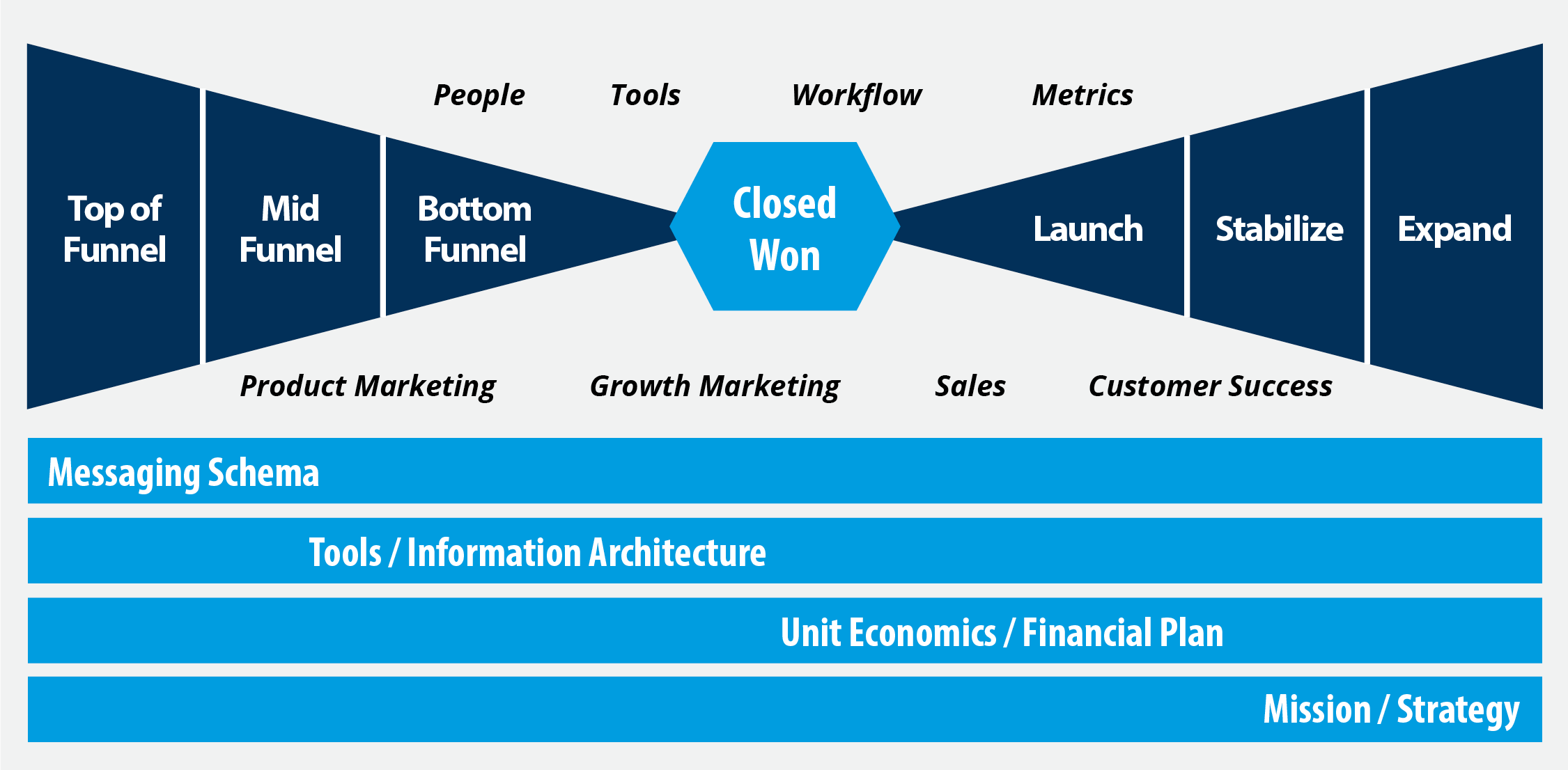
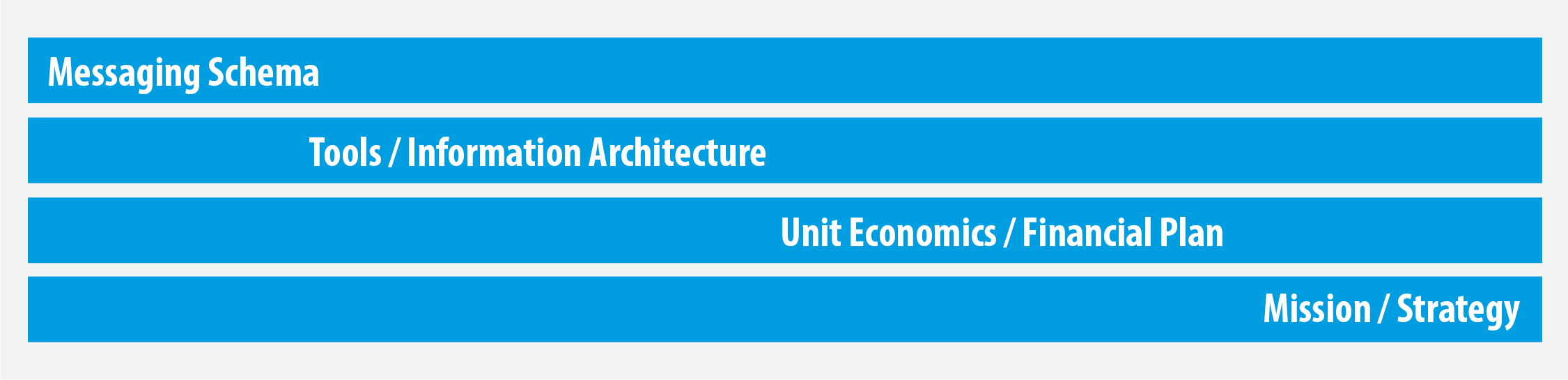
To make your revenue engine perform like a Porsche, you first need to attend to the engine’s foundational layers. Let’s go through each, working from the bottom up.
Mission / Strategy Layer
Mission, Vision, and Values:
These comprise your essential canon, your “north star,” which guides purpose, end in mind, and norms. Without clarity here, you don’t even know if you’re cutting a path through the right forest.
Customer Segmentation:
Segmentation is vital. It’s the starting point for the entire revenue engine. Done well, you will have a tight definition of the specific attributes of your target market and ideal customer profile (ICP).
For each top priority segment, you will know the buyer and user personas, the specific needs and pain points addressed, and the pricing demand curve. These, of course, will evolve over time, so it makes sense for you to regularly reassess your segmentation research.
Value Proposition:
Your value proposition defines the core functional value attributes that strongly resonate to your top priority segments, and that you can claim as unique.
Competitive Positioning:
Competitive positioning accentuates the value drivers that resonate for your top priority segments. You call out those attributes for which you have a strong competitive advantage. You express these attributes in a way that elevates your brand while boxing in your competitors.
Brand Identity:
With clear segmentation, strong value proposition, and compelling competitive positioning, you are ready to express your brand identity in four dimensions:
- Brand as company
- Brand as product
- Brand as person (the human-like traits of your brand)
- Brand as symbol (logo, other iconography, typography, etc.)
Product:
Your product road map is strategy in motion. The mission of product development is to drive revenue growth. So it’s important to first understand the “true problem” you must solve in development. True problems include value problems, velocity problems, retention problems, chasm crossing problems, segment expansion problems, or customer expansion problems.
An outward-in approach works best, leading you to the new features that will successfully address your true problem and meet the needs of your top priority segments.
Pricing and Packaging:
Smart pricing is transformational. It starts with understanding the segment-specific pricing demand curve. Key success factors include de-risking the entry point (initial pricing), pricing to penetrate, building an expansion of customer spend into the price structure, and capturing cash up front where possible.
Prospect and Customer Journey:
It’s critical to map the prospect and customer journey. Each step in that journey is a “moment of truth,” where the presence and quality of your messaging will influence the decision to proceed. As such, this journey map becomes the foundation for smart step-specific messaging and sales workflows.
Channel Architecture:
Channel strategy can transform a business. The first step is to identify all possible paths (partner based or internal) to the customer. Some common paths include ISV, system integrator, reseller, distributor, co-marketer, field sales team, inside sales team, or online channels. Next, you must choose your paths of preference and the specific partners you seek to secure.
After that, you need to engage potential partners effectively, building steadily towards a partnership deal. This requires knowing partner deal best practices and the traps to avoid. Finally, once you have secured the right partnerships and have defined your own direct sales channels, you must manage these pathways to the customer with high fidelity.
Unit Economics / Financial Plan Layer
Unit economics:
Unit economics establish the boundaries of your business. To chase revenue without regard to the LTV / CAC viability parameters is both irrational and reckless. On the contrary, you must instrument your business end to end so that you have constant visibility into the LTV / CAC impacts of all activities and workflows.
Pricing, variable costs, channel choices, customer acquisition practices, retention and expansion practices, and retention performance all impact unit economics. Metrics dashboards from all workflows should be structured to roll up to summary LTV / CAC calculations.
Financial Plan:
Metrics dashboards should start at the lowest level workflows and build up, like a pyramid, to overview metrics for the business. At the top of the pyramid is the financial plan. Here, one should find GAAP financials, headcount schedules, and all key strategic and operational metrics, with trending. All should show both Plan and Actual.
In a perfect world, “actuals” are populated via automatic links to source repositories of data (accounting, contracting, billing, the CRM, and product systems).
Tools / Information Architecture Layer
To optimize revenue engine performance, you have assembled vendor tools. This marketing and sales tools stack must be set up such that data flows seamlessly across the system in support of your end-to-end workflows, always yielding one source of truth. The architecture of your data should:
- Define your customer hierarchy (parent/child/grandchild relationships)
- Define stages of the prospect and customer lifecycle
- Define other key factors (billing arrangements, sales territory rules, etc.)
Messaging Schema Layer
Your messaging schema is your detailed blueprint (and the corresponding messaging assets) to guide day-to-day messaging execution at every stage of the prospect and customer journey.
Inside your messaging schema are the statements that achieve:
- Vision lock (“I understand what you refer to and why it’s relevant to me”)
- Conviction lock (“I’m convinced”)
- Advocacy lock (“I’m a raving fan”)
If your business model includes sales development reps, account executives, and customer success managers, then the messaging schema includes six playbooks (otherwise, just the first the first three):
- Brand playbook (the style guide)
- Product marketing playbook (the key focus areas, themes, and positioning objectives; the collateral assets and publishing calendar)
- Growth marketing playbook (the campaign objectives, campaign plan and testing plan)
- Sales development playbook (personas, programs, use cases and plays)
- Account executives playbook (from “opportunity” to “closed won” plan, pitch deck, plays)
- Customer success playbook (programs and plays).
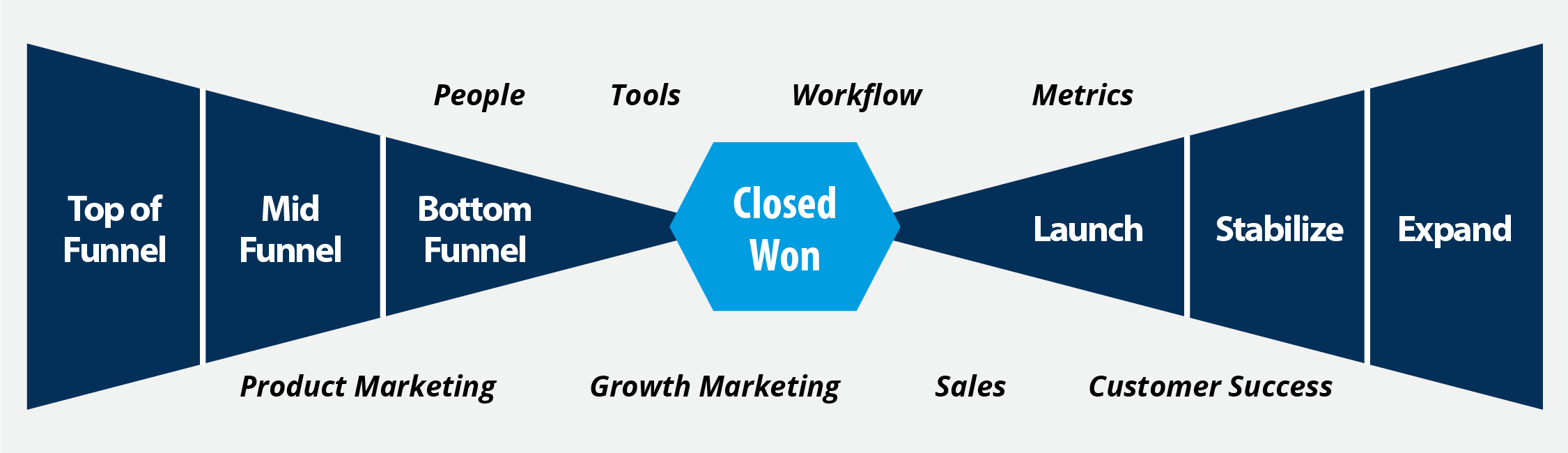
The Bow Tie
With these foundational layers in place, you can now execute workflows more effectively along the Bow Tie.