Most common Frameworks and Methods for Product Management
Many times when we practice product management, there are a few scientific methods that product managers follow to make it simple and very effective for the teams that they are working. So, what are the most common frameworks and methods for practicing product management by PMs, and here are 15 of them below.
1. Story Telling
Storytelling is actually the oldest way to deliver a message – or to explain the world. Ancient people used storytelling. The Bible uses storytelling. Your uncle uses storytelling. Product Manager use storytelling. You’re using storytelling for yourself and your business, even if you don’t call it exactly that. Its is the foundation for effective communication in general and a solid foundation for a couple of the frameworks listed below as well.
Storytelling at it’s most basic structure is about a Situation / Problem (Hero and Enemy), Needs (Conflict and Painpoints) and a Solution. Well, that’s right there 3 integral elements to be managed by Product Managers.
If we follow this structure it makes it easy for the listener to follow. Story is “a thing that does” rather than “a thing that is”. It is a tool with measurable utility rather than an object for aesthetic admiration.
See also:
In its basic form these are the Steps:
Step 1: You — What, Who is this story about?
Step 2: Need — Problems, painpoints, Needs, Issues, Challenges
Step 3: Go — Cross the threshold into ‘the upside down’
Step 4: Search and Alternatives — How can “you” achieve your goal?
Step 5: Find a Solution — The meeting with the Goddess
Step 6: Take / Apply
Step 7: Return (How does this relate to the Goal)
Step 8: Wrapping up
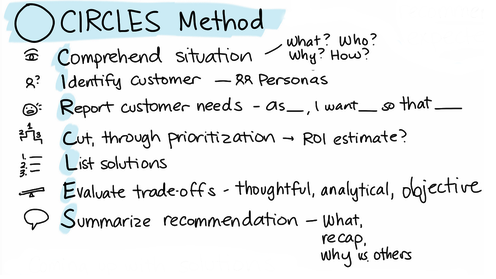
2 Product Design: CIRCLES Method by Lewis Lin
In my mind the Circles Method is based on the above storytelling concept. Very similar to DIGS, just adapted for it’s purpose.
The CIRCLES Method™ is a framework on what makes a complete, thoughtful response to any product design. It’s an aid that prevents us from forgetting a step. You can also think of it as a checklist or guideline.
The 5W’s & H also help product manager in asking a right question in the Comprehend Situation stage and gather information about the problem before jumping into solution or some conclusion.
- What is it?
- Who is it for?
- Why do they need it?
- When is it available?
- Where is it available?
- How does it work?”
3: Metrics AARRR: Startup Metrics for Pirates
A very helpful framework by Dave McClure,
500 Startups for product managers who need to define success metrics for any product or feature.
- Acquisition — How users find you / where or what channels do users come from? E.G Tracking customer signups for a service.
- Activation — An initial experience great experience?
- Retention — Do they come back and re-visit over time?
- Revenue — Can you monetize any of this behavior?
- Referral — Do they like it enough to tell their friends?
4: Metrics for UX design: HEART
The
HEART framework designed by
Kerry Rodden, Hilary Hutchinson and
Xin Fu, from Google’s research team.
5: 4 Quadrants Time Management: Matrix
We live in a time pressured world where it is common to have multiple overlapping commitments that all require immediate attention now. Urgency is no long reserved for special occasions, they are an everyday occurrences. Missing deadlines is not the path to advancement or even good job reviews. So how can one manage the flood of responsibilities, do excellent work and maintain a positive frame of mind? The Covey time management grid is a simple yet effective method of organizing your priorities. As you can see from the grid below, there are four quadrants organized by urgency and importance.
Before responding to any request, filter them through the Matrix.
- Quadrant I – important deadlines with high urgency
The first quadrant contains tasks and responsibilities that need immediate attention.
- Quadrant II – long-term development and strategizing
The second quadrant is for items that are important without requiring immediate action. Covey points out that this quadrant should be used for long-term strategizing.
- Quadrant III – distractions with high urgency
The third quadrant is reserved for tasks that are urgent, without being important. Covey recommends minimizing or even eliminating these tasks as they do not contribute to your output. Delegation is also an option here.
- Quadrant IV – activities with little to no value
The fourth and last quadrant focuses on tasks and responsibilities that do not yield any value—items that are unimportant and not urgent. These time wasters should be eliminated at any costs.
The Bottom Line: Do Important things first!
Using The Matrix
The matrix has many applications, two will be suggested here. The first and most obvious use of the matrix is to take your current ‘to-do’ list and sort all the activities into the appropriate grid. Then, assess the amount of time you have to accomplish the lists and, if necessary, reallocate activities.
The second approach is a one week assessment strategy. Make six copies of the matrix and use one matrix for each day of the week, listing all activities and time spent. At the end of the week, Combine the five individual day data onto one summary matrix (number 6) and calculate the percent of time in each matrix. Then evaluate how well your time is spent and whether you work load needs to be reorganized.
6: 5 Why’s Framework
How to get requirement right? What is the exact problem? Are you solving the right problem? This 5 Why’s framework helps product manager to get to the root cause easier.
7: Prioritization
Once you decide the list of features or request which you plan to work, but wondering which one to pick or test first, below prioritization frameworks help you in that:
- Weighted Scoring
- Impact vs Effort
- Weighted scoring
- Kano Model
Your good product management skills will come into play during the process. Suggestions regardless of the prioritization method you choose:
- Approach prioritization as a team activity; not only is does it create buy-in on the team, you get different perspectives. It’s also a lot more fun.
- Limit the number of items you are prioritizing – focus on the biggest items rather than the details.
- Categorize and group initiatives together into strategic themes (for example, “improving satisfaction” for a particular persona would be a good way to group).
- Before you begin prioritizing, it’s helpful if you understand the customer value for each initiative. The customer value should be rooted in evidence that you’ve gathered from customers rather than your opinions.
- Before you begin, have a rough estimate of cost. Even T-shirt sizing of “small” “medium” and “large” will be helpful during the process.
8: The Four Ps Model / 4P’s of Marketing
4 P’s framework helps in putting the right product at the right price in the right place at the right time.

- Product – The first of the Four Ps of marketing is a product. A product can be either a tangible good or an intangible service that fulfills a need or want of consumers. Whether you sell custom pallets and wood products or provide luxury accommodations, it’s imperative that you have a clear grasp of exactly what your product is and what makes it unique before you can successfully market it.
- Price – Once a concrete understanding of the product offering is established we can start making some pricing decisions. Price determinations will impact profit margins, supply, demand, and marketing strategy. Similar (in concept) products and brands may need to be positioned differently based on varying price points, while price elasticity considerations may influence our next two Ps.
- Promotion – We’ve got a product and a price now it’s time to promote it. Promotion looks at the many ways marketing agencies disseminate relevant product information to consumers and differentiate a particular product or service. Promotion includes elements like advertising, public relations, social media marketing, email marketing, search engine marketing, video marketing and more. Each touch point must be supported by a well-positioned brand to truly maximize return on investment.
- Place – Often you will hear marketers saying that marketing is about putting the right product, at the right price, at the right place, at the right time. It’s critical then, to evaluate what the ideal locations are to convert potential clients into actual clients. Today, even in situations where the actual transaction doesn’t happen on the web, the initial place potential clients are engaged and converted is online.
9: 5 C’s of Product Pricing
What is the best price for your products or services? This 5 C’s framework helps to determine the optimum price tag for your product.
- Cost
- This is the most obvious component of pricing decisions. You obviously cannot begin to price effectively until you know your cost
- Compatibility / Company objective
- Is your pricing approach compatible with your marketing and sales objectives?
- Customer
- The ultimate judge of whether your price delivers a superior value is the customer.
- Competitor
- Think about the buyers point of view
- Channel: Distribution Channel
- Think about the “middlemen”, margins to motivate, value-add they bring.
10: REAN : Digital Marketing Strategy Model
The question behind this model: “How am I going to reach/engage/activate/nurture my potential or current customers?
What should your digital strategy look like? How should you market your product? Are you using the right channels? The REAN model, popularised by Steve Jackson helps product manager or product marketers to answers those questions easier.
11: AIDA(R) Framework
The AIDA framework is also popularly used to optimize marketing channel and communication. It describes the effect of advertising media and helps to explain how an advertisement or marketing communications message engages and involves consumers in brand choice.
- Awareness: creating brand awareness or affiliation with your product or service.
- Interest: generating interest in the benefits of your product or service, and sufficient interest to encourage the buyer to start to research further.
- Desire: for your product or service through an ’emotional connection’, showing your brand personality. Move the consumer from ‘liking’ it to ‘wanting it’.
- Action: CTA – Move the buyer to interact with your company and taking the next step ie. downloading a brochure, making the phone call, joining your newsletter, or engaging in live chat etc.
- Retention: We all know that this is key to upsell, cross-sell, referrals, Advocacy, and the list goes on.. as companies are also focussing on LTV.
The additional “R” is sometimes added by some Marketers to show the importance of ongoing relationship building.
12: RFM : Customer Segmentation Model
The term RFM stands for Recency, Frequency and Monetary Value and it describes a marketing approach for analyzing customer value which is becoming increasingly popular in the e-commerce industry where businesses are starting to focus more on retention strategies. It’s a good customer segmentation technique based on user behavior. It groups customers based on their history how recently, how often and how much.
- Recency
- Frequency
- Monetization
13: Porter 5 Forces
Porter’s Five Forces is a simple but powerful tool for understanding the competitiveness of your product, and for identifying your strategy’s potential profitability. It helps you for product strategy & roadmap planning.
- Threat of New Entry. Your position can be affected by people’s ability to enter your market. So, think about how easily this could be done.
- Threat of Substitution. This refers to the likelihood of your customers finding a different way of doing what you do.
- Supplier Power. This is determined by how easy it is for your suppliers to increase their prices.
- Buyer Power. How easy it is for buyers to drive your prices down.
- Competitive Rivalry: This looks at the number and strength of your competitors.
By thinking about how each force affects you, and by identifying its strength and direction, you can quickly assess your product position in the market. You can then look at what strategic changes you need to make to deliver long-term profit.
more details on how to use it
here.
14: STAR
STAR a popular method to tell stories about accomplishments during interviews.
- Situation
- Task
- Action
- Result
15: DIGS
A slightly adapted version to STAR is the
DIGS framework by
Lewis C. Lin which also helps to answer the behavioral question in a structured and impactful way. It is closer to the storytelling methodology and emphasis on creating “higher” stakes.
- Dramatize the situation
- Indicate the alternative
- Go through what you did
- Summarize your project
Source:
http://davidolszewski.com/top-15-frameworks-every-product-manager-wants-to-know